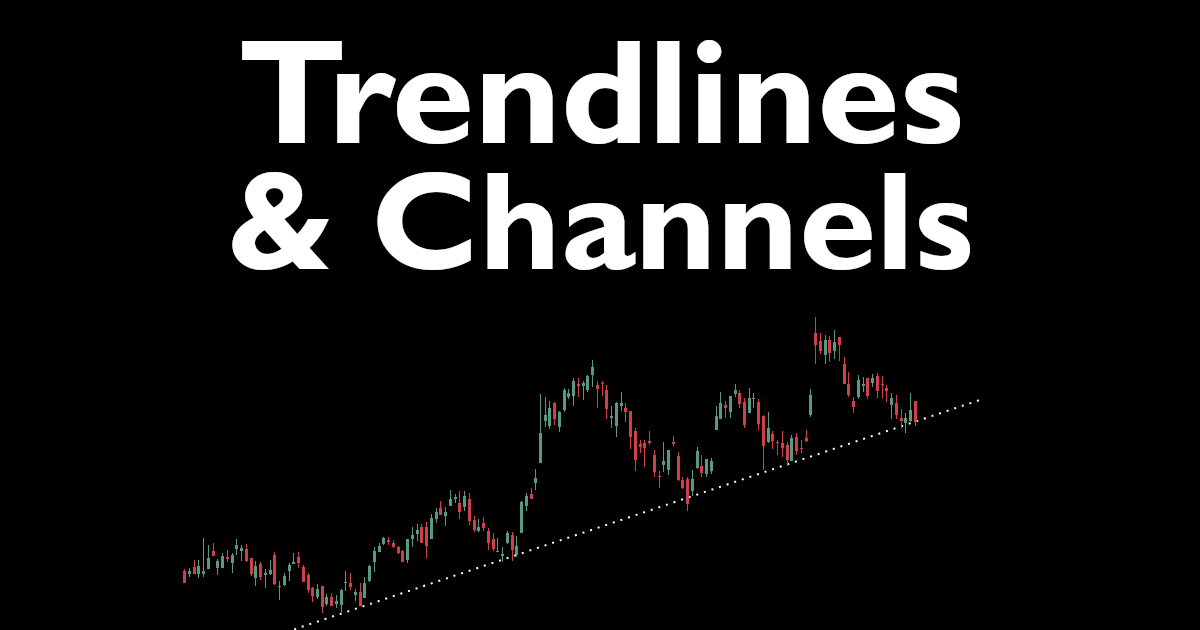
Trend lines are one of the oldest tools in technical analysis, and they've survived for a reason: price doesn't move in a straight line, but it does move in a direction. Trend lines give you a way to visualize that direction, identify where price is likely to find support or resistance, and spot the moment when a trend is beginning to break down. Channels take it one step further by giving you both walls of the price corridor, creating a framework for entries, exits, and risk management that's remarkably clean.
This article will teach you how to draw trend lines and channels correctly, explain the market forces that make them work, and give you a concrete assignment to build real skill with the tool.
What Is a Trend Line and How Does It Work?
A trend line is a straight line drawn across successive price pivots. In an uptrend, you connect two or more higher lows. In a downtrend, you connect two or more lower highs. The resulting line acts as a dynamic support or resistance level, moving in the direction of the trend alongside price.

But why do trend lines work at all? The answer lives in the overlap between institutional order flow and trader psychology. Large institutions, think mutual funds, pension funds, and hedge funds, don't dump their entire position in a single day. They scale in and out over time. As price rises and pulls back toward a trend line, those same institutions often add to their positions at perceived value levels. Retail traders, who have been watching the pattern hold repeatedly, pile on as well. The result is a self-reinforcing mechanism. The more times a trend line holds, the more market participants expect it to hold, which makes it more likely to hold. Until it doesn't.
That last part is important. Trend lines fail. When they do, the failure itself becomes a trade signal, because it flushes out the traders who were leaning on the line and attracts momentum traders on the other side. This is why a clean break of a well-respected trend line often leads to a sharp, accelerated move in the breakout direction.
How To Draw a Trend Line Correctly: 3 Rules Every Trader Should Know
- Use closing prices, not wicks. Intraday wicks represent noise, stop hunts, and brief liquidity grabs. Closing prices reflect where market participants were willing to hold positions overnight. Connecting closing prices produces a more reliable trend line in most cases, though some traders prefer to connect the extreme wicks when identifying major support and resistance zones.
- Two points define the line, three points validate it. Any two points can create a line. A third touch at the same angle without penetrating it confirms that market participants are actually reacting to that level. This is your validation signal.
- Steeper is not stronger. Trend lines with slopes above 45 degrees are typically unsustainable. The steeper the line, the sooner it will be violated. A gradual, steady trend line that has held across dozens of bars is far more meaningful than a parabolic one that's only a few weeks old.
What Is a Price Channel and How To Use It for Trading
A price channel is formed by drawing a second line parallel to your trend line on the opposite side of price. In an uptrend, you draw the primary trend line below the lows and then draw a parallel channel line above the swing highs. This creates an upper and lower boundary, and price tends to oscillate between them.

The logic here is anchored in mean reversion and measured institutional participation. When price reaches the upper channel line in an uptrend, it has temporarily outpaced demand. Short-term sellers emerge, taking profits and creating friction. When price drifts back to the lower trend line, the patient buyers return. Algorithms that track price relative to moving averages and bands often respond to these same channel boundaries automatically, reinforcing the behavior with mechanical precision.
Channels give you three actionable trade scenarios:
- Trend continuation trade: Buy the lower channel line (support in an uptrend) or short the upper channel line (resistance in a downtrend).
- Channel breakout trade: When price closes convincingly beyond one of the channel lines, it signals a potential acceleration in that direction or the start of a new trend.
- Channel breakdown trade: A decisive close through the primary trend line signals that the prior trend may be reversing, offering a countertrend opportunity.
How To Identify High-Quality Channel Setups That Are Worth Trading
Not every channel is worth your attention. Here's what separates a high-quality setup from background noise:
- At least three alternating touches between the two channel lines
- Relatively uniform oscillations—price shouldn't be hugging one wall for extended periods
- Volume expanding on moves toward channel boundaries and contracting during the middle of the range
- The channel slope aligns with the broader market trend or the stock's sector trend
If a channel check all four boxes, you have a setup worth planning a trade around. If it only checks two, treat it as background context, not a primary signal.
The Strategy: Andrew's Pitchfork for Trading Channels
Dr. Alan Andrews, a private trader and educator who taught his methods primarily in the mid-20th century, developed a tool called Andrews' Pitchfork. It's available as a drawing tool in TradingView and therefore in the Trading Blitz simulator. The concept is built on a principle Andrews called the median line theory: price tends to return to the median line connecting a major pivot high and low roughly 80% of the time, according to Andrews' own research and later documented by Tim Morge, a professional trader who studied and extended Andrews' work extensively.

The pitchfork uses three pivot points: a major high or low (Point A), followed by the next significant low (Point B), and then the next significant high (Point C). The tool draws three parallel lines: a median line from Point A through the midpoint of B and C, an upper parallel line through Point C, and a lower parallel line through Point B. This creates a channel with a built-in median target. Trades are taken when price touches one of the outer lines and then targeted toward the median.

Tim Morge, a former institutional trader who worked with large banks, popularized the pitchfork in the modern trading community. His approach emphasizes patience, waiting for price to tag the outer line cleanly before entering, and using the median as a realistic first target.
Assignment: Practice Trend Lines and Channels
Here is your assignment, structured around Andrews' Pitchfork and basic channel trading:
- Reset your Game History on your Dashboard to ensure you won't have any old data in your statistics for this test.
- Load a new chart and spend time examining the chart history that loads. Look for a clearly visible swing sequence with at least three prominent pivot points.
- Identify your three anchor points for the pitchfork: a major pivot (A), the next swing low (B), and the next swing high (C) for an upward-sloping pitchfork, or reverse for a downward one. Draw the pitchfork using the Andrews' Pitchfork tool under TradingView's drawing tools.
- Wait for price to tag the outer parallel line. Do not enter the moment the pitchfork is drawn. Click through days patiently until price reaches one of the outer rails cleanly.
- Enter with a limit order at the outer rail and set a stop loss just beyond the rail. Your first target is the median line.
- Record your observations in the Notes section of the simulator.
- View your results. After twenty trades, review your statistics on the Dashboard and compare them with your recorded observations. Were the outer rails holding? Did price reach the median? Use the dashboard statistics to measure your win rate on this specific setup.
If you want to filter for stocks showing strong trend structure, Premium users can use the Breakout or Pullback filters to find charts that already show directional momentum, which makes pitchfork anchoring significantly easier.
Treat every session on the simulator like real money is on the line. The habit of disciplined entry, defined risk, and a realistic target is the entire point. The pitchfork is just the framework. Your job is to develop discipline.
Free Cash-Prize Touraments
We run free cash-prize tournaments (no entry fee required) when we go live on YouTube. Be sure to subscribe to our channel - @TradingBlitzSimulator - to get alerted when we go live next.
Citations and References
- Morge, Tim. The Median Line Study. Available at medianline.com. Morge has documented the 80% median line return statistic based on Andrews' original research and his own institutional trading experience.
- Murphy, John J. Technical Analysis of the Financial Markets. New York Institute of Finance, 1999. A foundational reference for trend line construction and channel theory.
- Pring, Martin J. Technical Analysis Explained, 5th Edition. McGraw-Hill, 2014. Covers trend line validation, slope interpretation, and channel trading mechanics.
Disclaimer: Trading involves substantial risk of loss and is not appropriate for all investors. The information provided on Trading Blitz is for educational and informational purposes only. Nothing on this platform, including this article, constitutes financial advice, investment advice, or a recommendation to buy or sell any security. Simulated trading results do not guarantee or predict future performance in live markets. Past performance, whether real or simulated, is not indicative of future results. Always consult a qualified financial professional before making any investment decisions. For additional information, please see our Terms of Service.
Affiliate Disclosure: Some links in this article may be affiliate links. If you click through and make a purchase, Trading Blitz may earn a small commission at no additional cost to you. We only reference tools and resources we believe are relevant to traders.