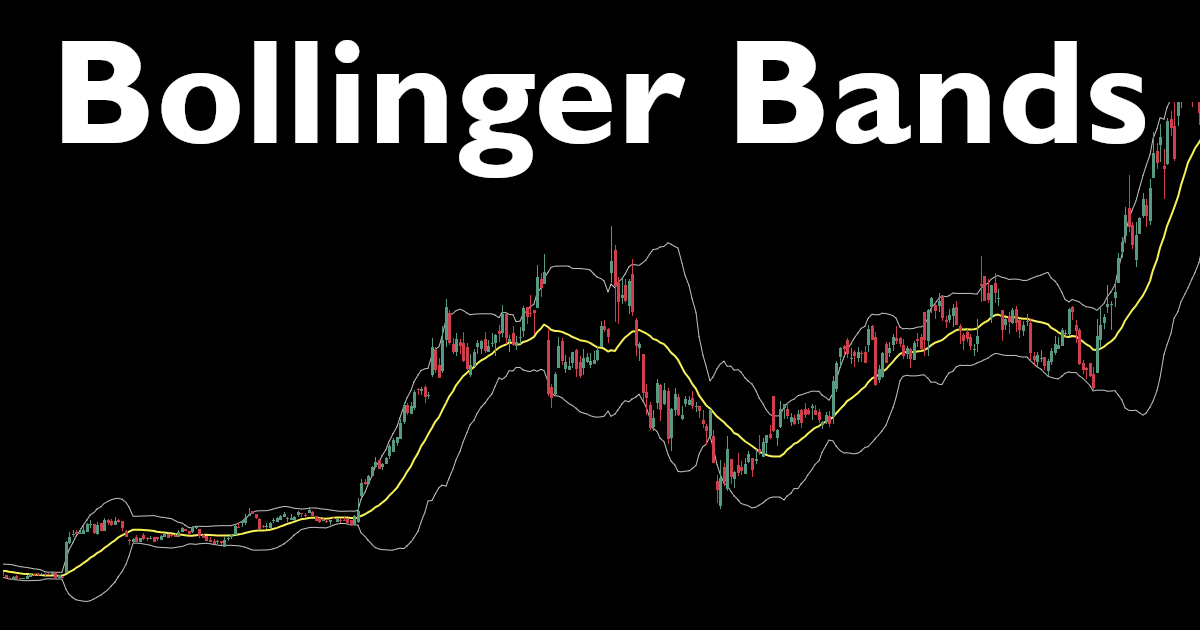
Bollinger Bands are one of the most widely recognized tools in technical analysis, yet most traders only scratch the surface of what they can actually tell you. Developed by John Bollinger in the early 1980s, the indicator wraps a simple moving average with two standard deviation bands that expand and contract based on price volatility. That dynamic behavior is precisely what makes them so useful, and so misunderstood.
By the end of this article, you'll know how Bollinger Bands work, why they behave the way they do, and how to use them to identify high-probability setups, and practice using them in real chart conditions.
What Are Bollinger Bands and How Do They Work?
The structure is straightforward. There are three lines:
- Middle Band: A 20-period simple moving average (SMA)
- Upper Band: 2 standard deviations above the 20-period SMA
- Lower Band: 2 standard deviations below the 20-period SMA
Standard deviation measures how spread out price has been relative to its average. When price moves erratically, the bands widen. When price consolidates and chops sideways, the bands tighten. This is the core insight: Bollinger Bands are a volatility envelope, not a price target system.
John Bollinger himself noted that approximately 88-89% of price action occurs inside the bands when using the default 2 standard deviation setting. That doesn't mean price touching the upper band is a sell signal. It means price is statistically extended relative to recent behavior. Big difference.
Why Do Bollinger Bands Expand and Contract? The Market Forces Behind It
To understand why Bollinger Bands behave predictably, you need to understand what drives volatility itself. Markets cycle between two states: trending and consolidating. These aren't random, they're driven by institutional behavior.
Large funds and algorithmic systems don't buy all at once. They accumulate positions gradually during quiet, low-volume periods, which suppresses volatility and tightens the bands. Once a position is fully built, price moves sharply, either because the catalyst arrives or because the smart money is done accumulating and starts letting price run. That breakout expands the bands rapidly.
Retail traders tend to pile in after the move is visible, which adds fuel but also creates the conditions for the next consolidation phase when the initial buyers begin to distribute. This cycle of accumulation, breakout, distribution, and consolidation repeats across virtually every timeframe and market, and Bollinger Bands capture the volatility signature of each phase.
3 High-Probability Bollinger Band Setups Every Trader Should Know
1. The Bollinger Band Squeeze: How To Identify Low-Volatility Breakout Conditions
The squeeze is arguably the most powerful signal the indicator generates. When the bands compress to their tightest point in weeks or months, it signals that a significant move is likely approaching. The direction isn't always obvious in advance, but the compression itself is the alert.

John Bollinger created a companion indicator called the Bandwidth indicator to quantify the squeeze mathematically. When bandwidth drops to a multi-month low, historically this has preceded some of the largest single-stock moves in market history. The logic is simple: compressed volatility is stored energy. Markets cannot stay quiet forever, and when the coil releases, it releases hard.

The key is waiting for a confirmed directional break before committing. A candle closing decisively outside the band on above-average volume is a meaningful signal. A close barely touching the band on light volume is noise.
2. Walking the Band: How To Stay in Trending Trades Using Bollinger Bands
One of the most counterintuitive things Bollinger taught was that price touching or hugging the upper band during a strong uptrend is not a sell signal — it's a strength signal. When price "walks the band," repeatedly closing near the upper band over multiple sessions, that's a trend worth riding, not fading.
The middle band (20 SMA) acts as dynamic support during these trends. A pullback to the middle band in an uptrend often provides a cleaner, lower-risk entry point than chasing the initial breakout. Many professional traders use this as a re-entry technique after missing the first move.
3. The W-Bottom and M-Top: How To Spot Reversals with Bollinger Band Patterns
John Bollinger documented six specific pattern types that use the bands as context for reversal setups. The most reliable are the W-Bottom and M-Top, which he detailed in his 2001 book Bollinger on Bollinger Bands.
A W-Bottom forms when price makes a first low that touches or breaks the lower band, rallies back toward the middle band, then makes a second low that holds above the lower band. That second low, even if price appears to be lower, represents diminishing selling pressure — sellers are losing strength. A close above the middle band after the second low confirms the pattern.
The M-Top mirrors this in reverse: two highs near the upper band where the second high fails to reach or exceed the first, followed by a close below the middle band. It's a clean distribution signal baked right into the bands' structure.

What Bollinger Bands Cannot Do: Avoiding Common Mistakes
The most expensive mistake traders make is treating the bands as automatic buy/sell triggers. Price hitting the upper band does not mean sell. Price hitting the lower band does not mean buy. That logic fails badly in trending markets and will blow up an account during a strong directional move.
Bollinger Bands work best when combined with a momentum indicator — John Bollinger himself recommended pairing them with RSI, MACD, or On-Balance Volume (OBV) to confirm signals. The bands tell you where price is relative to volatility. A momentum indicator tells you whether price has the energy to follow through.
Additionally, the default 20-period setting isn't sacred. Shorter-term traders sometimes tighten it to 10 periods for more sensitivity. Longer-term position traders may use 50 periods. The standard deviation multiplier can also be adjusted — Bollinger suggested using 2.5 standard deviations if you shorten the period, and 1.5 if you lengthen it.
How To Practice Bollinger Band Strategies on the Trading Blitz Simulator
The strategy for this assignment is based on John Bollinger's own Squeeze and Breakout method, adapted for daily chart practice. Here's how to run the drill:
The Assignment: John Bollinger's Squeeze Breakout Strategy
- Reset Game History in Dashboard to ensure you're not including old data in your results.
- Load a new chart and add Bollinger Bands (default 20, 2) and MACD to your chart layout. Add the Bollinger Bands Width indicator as well to help visually identify the squeeze.
- Look for the squeeze. Scroll through the loaded chart history and identify a period where the bands visibly compress — the upper and lower bands are running nearly parallel and close together. Bandwidth should be at or near a multi-week low.
- Wait for the breakout candle. Start advancing days and watch for a candle that closes clearly outside either band. Do not enter on the first touch — wait for a close.
- Confirm with MACD. Check that the MACD histogram is expanding in the direction of the breakout. A MACD crossover on or near the breakout day adds significant confidence.
- Enter a market order in the direction of the breakout on the following day's open (i.e., click Next Day and place a market order).
- Set your stop loss at the opposite band or just below/above the middle band, depending on your risk tolerance.
- Exit when price walks back inside the bands and MACD begins to roll over, or when price reaches the opposite band after a strong move.


Run this drill across at least twenty charts. Track how many squeezes produce genuine breakouts versus false moves, and note whether MACD confirmation improved your accuracy. Premium users can use the Breakout filter to load charts that have already been flagged for breakout conditions, which speeds up finding relevant setups to practice.
Treat every session like real capital is on the line. Use position sizing consistently — don't bet the full account on one idea. Traders who practice this way build pattern recognition that transfers directly to live markets.
Free Cash-Prize Touraments
We run free cash-prize tournaments (no entry fee required) when we go live on YouTube. Be sure to subscribe to our channel - @TradingBlitzSimulator - to get alerted when we go live next.
Citations
- Bollinger, J. (2001). Bollinger on Bollinger Bands. McGraw-Hill.
- Bollinger, J. (1983). Bollinger Bands. Originally presented at the Financial News Network.
- Murphy, J.J. (1999). Technical Analysis of the Financial Markets. New York Institute of Finance. pp. 209-212.
- CMT Association. (2019). CMT Curriculum Level I. Wiley.
Disclaimer: Trading involves substantial risk of loss and is not appropriate for all investors. The information provided on Trading Blitz is for educational and informational purposes only. Nothing on this platform, including this article, constitutes financial advice, investment advice, or a recommendation to buy or sell any security. Simulated trading results do not guarantee or predict future performance in live markets. Past performance, whether real or simulated, is not indicative of future results. Always consult a qualified financial professional before making any investment decisions. For additional information, please see our Terms of Service.
Affiliate Disclosure: Some links in this article may be affiliate links. If you click through and make a purchase, Trading Blitz may earn a small commission at no additional cost to you. We only reference tools and resources we believe are relevant to traders.