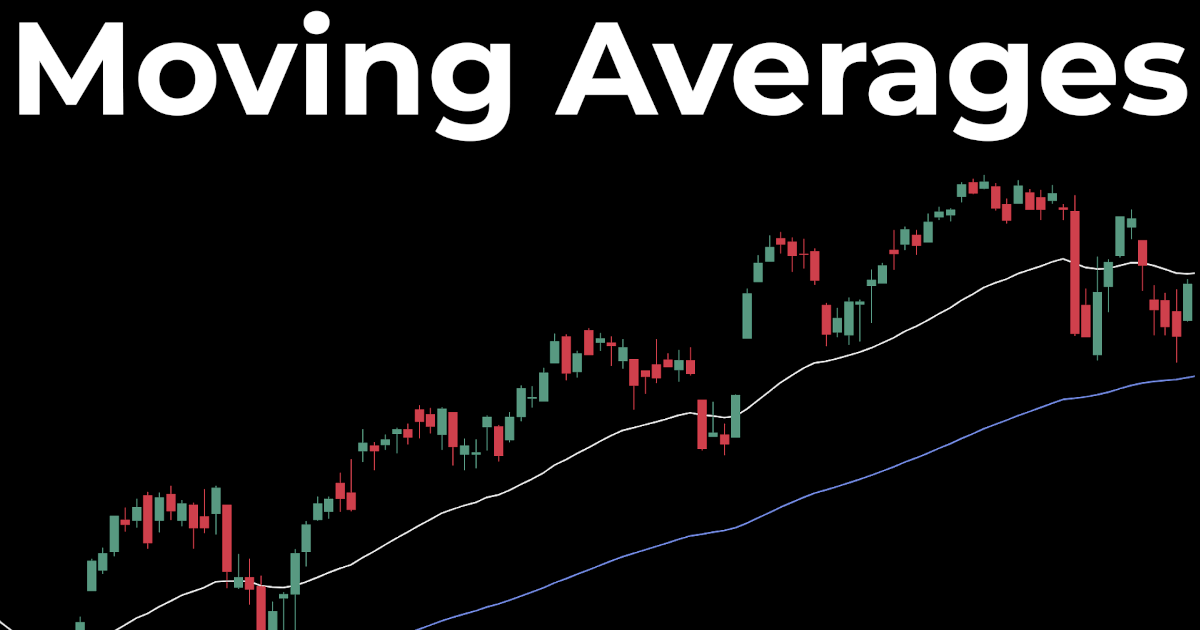
Moving averages are the bread and butter of technical analysis. They smooth out the noise in price data and help traders identify trends, spot potential reversals, and time entries and exits with more confidence. If you've ever looked at a chart and felt overwhelmed by the jagged, random-looking price action, a moving average is essentially your translator. It converts chaos into something readable.
There are two types you'll typically encounter: the Simple Moving Average (SMA) and the Exponential Moving Average (EMA). They're related, but they behave differently, and knowing when to use each one can meaningfully change your trading results. This article breaks down both, explains the math behind them (without making your eyes glaze over), and shows you exactly how professional traders put them to work.
What Is a Simple Moving Average and How To Calculate It
The Simple Moving Average is exactly what it sounds like. Take the closing prices over a set number of days, add them up, and divide by the number of days. A 20-day SMA adds the last 20 closing prices and divides by 20. Every day, the oldest price drops off and the newest one gets added. Clean, straightforward, no tricks.
The SMA gives equal weight to every price in the window. Day 1 matters just as much as Day 20. That's both its strength and its weakness. Because it treats all data points equally, it's slower to react to recent price changes. It won't whipsaw you with false signals as much, but it also won't warn you about a trend change until after the price has already moved significantly.
Institutional investors often use longer-period SMAs (e.g. the 50-day or 200-day) as reference levels for portfolio rebalancing decisions. When a major index crosses below its long-term SMA, institutional algorithms often trigger defensive positioning. That kind of mechanical, rules-based behavior is precisely why these levels tend to act as self-fulfilling support and resistance zones. It's not magic, it's millions of dollars in programmatic orders stacking up at the same price.
What Is an Exponential Moving Average and Why It Reacts Faster
The Exponential Moving Average uses the same basic idea but applies a multiplier that gives more weight to recent prices. The formula involves a smoothing factor: 2 ÷ (number of periods + 1). For a 10-day EMA, that multiplier is approximately 0.18. Each new closing price receives 18% of the total weight, while the previous EMA value carries the remaining 82%.
The practical result? The EMA hugs price more closely and responds to new information faster than the SMA. When price reverses, the EMA turns earlier. When momentum picks up, the EMA accelerates sooner. This is why short-term and momentum traders tend to prefer EMAs—they want signals that are timely, not historical.
The tradeoff is sensitivity to noise. Because the EMA reacts quickly, it can generate more false signals in choppy, sideways markets. A stock grinding sideways for three weeks will cause an EMA to zigzag without producing any meaningful directional information. The SMA, by contrast, will stay relatively flat and correctly communicate that there's no real trend to follow.
3 Key Differences Between SMA and EMA Every Trader Should Know
- Speed of reaction: EMAs respond to price changes faster. SMAs lag more but filter out more noise.
- Best market conditions: EMAs work well in trending markets. SMAs are often preferred in range-bound or long-term trend analysis.
- Signal quality: SMA crossover signals tend to be fewer but more reliable. EMA crossover signals appear earlier but come with more false positives in choppy conditions.

How To Use Moving Average Crossovers To Identify Trend Changes
One of the most widely used moving average strategies is the crossover. The concept is simple: plot two moving averages of different lengths. When the shorter one crosses above the longer one, that's a bullish signal. When it crosses below, that's a bearish signal.
The famous "Golden Cross" occurs when a 50-day SMA crosses above a 200-day SMA, a historically bullish signal. Research published by Ned Davis Research found that the S&P 500 produced an average annual gain of roughly 9.7% when trading above its 200-day SMA, compared to a loss of around 1.5% below it (data through 2013). The institutional response to these levels is a big reason why they're reliable — not because the moving average itself predicts the future, but because enough market participants act on it to create a measurable outcome.
For shorter-term traders, the 9-day EMA / 21-day EMA crossover is a popular setup. It fires earlier than SMA-based crosses and catches more of the move, but requires stricter risk management to handle the noise.

What Is the Best Moving Average Period To Use for Day and Swing Trading
The honest answer: it depends on your holding period and trading style. Here's a practical guide:
- Short-term swing traders (3-10 day holds): 9 EMA and 21 EMA are popular. Fast signals, trend-following but nimble.
- Medium-term swing traders (2-6 week holds): 20 SMA or 50 SMA. These smooth out daily noise while still reflecting the intermediate trend.
- Position traders and long-term investors: 50 SMA and 200 SMA. These are the levels institutional desks watch, making them high-probability reference points.
There's no universally "correct" period. The key is consistency. Pick your parameters, stick with them long enough to evaluate performance, and avoid the trap of curve-fitting your settings to look perfect on past charts.
How Professional Traders Use Moving Averages as Dynamic Support and Resistance
Beyond crossovers, moving averages function as dynamic support and resistance levels. In an uptrend, price will often pull back to the 20-day or 50-day SMA and then bounce. In a downtrend, rallies frequently stall at these same levels.
Why does this happen? Part of it is institutional program trading. Algorithms are literally programmed to buy pullbacks to certain moving averages and sell rallies to others. Part of it is retail psychology—millions of traders watch the same lines and place limit orders near them, creating liquidity clusters that naturally attract and repel price.
Legendary trader Mark Minervini, a two-time U.S. Investing Champion, specifically uses the 10-week (50-day) moving average as a key reference level for identifying base formations and re-entry points in trending stocks. In his book Trade Like a Stock Market Wizard (Buy on Amazon), he describes stocks that pull back to their 50-day MA during an uptrend as potentially offering low-risk entry opportunities — provided the overall market environment is healthy and the stock shows signs of accumulation. His SEPA (Specific Entry Point Analysis) methodology looks for tight price consolidations near this level before a breakout to new highs.

How To Practice Moving Average Strategies on the Simulator
Your assignment is to practice Mark Minervini's 50-day moving average pullback entry strategy using the Trading Blitz simulator.
Strategy Rules
- Reset Game History: Before you begin, be sure to reset your game history (Dashboard) to ensure you don't include any old data in your test results.
- Identify the trend: Load new charts until you find one where the stock has been making higher highs and higher lows over the visible price history. The 50-day SMA should be sloping upward.
- Wait for a pullback to the 50-day SMA: As you advance through the trading days (clicking Next Day), look for the price to pull back and touch or approach the 50-day SMA without breaking down through it aggressively.
- Look for a tight consolidation or bounce candle: You want to see the stock tighten up near the moving average (small daily ranges, low volatility) or a clear hammer/bullish candle indicating buyers are stepping in.
- Enter long on confirmation: Place a limit order or market order when price shows a clear bounce from the 50-day SMA. The next day's price action closing higher than the bounce day's open is a reasonable confirmation signal.
- Place your stop loss: Set a stop loss below the low of the pullback candle or just below the 50-day SMA. Minervini is strict about cutting losses quickly — typically limiting losses to 7-8% of the entry price at most.
- Target and exit: Advance the days and look to exit if the stock makes a new high and shows signs of stalling, or if it closes back below the 50-day SMA on strong volume.
How To Set Up Your Chart
Add the Simple Moving Average indicator to your chart. Set the period to 50. Optionally, add a second SMA set to 200 to confirm the longer-term trend. Premium users can filter for "Pullback" patterns to find charts already in a pullback setup, saving setup time.
What To Track
Run at least 10 trades using this strategy. After each trade, note whether the 50-day SMA was sloping up, whether the pullback was shallow (less than 10-15%), and whether volume contracted during the pullback (a sign of weak selling, not capitulation). Over 10 trades, patterns in your wins and losses will begin to reveal whether you're applying the rules correctly or making execution errors.
Treat every simulated trade like real money is on the line. That mindset shift is what separates traders who actually improve from those who just click through charts for fun.
Free Cash-Prize Touraments
We run free cash-prize tournaments (no entry fee required) when we go live on YouTube. Be sure to subscribe to our channel - @TradingBlitzSimulator - to get alerted when we go live next.
Citations
- Minervini, Mark. Trade Like a Stock Market Wizard. McGraw-Hill Education, 2013.
- Ned Davis Research. S&P 500 performance relative to the 200-day moving average. Data cited through 2013 in multiple technical analysis publications, including Investopedia's coverage of the 200-day SMA significance.
- Murphy, John J. Technical Analysis of the Financial Markets. New York Institute of Finance, 1999.
Disclaimer: Trading involves substantial risk of loss and is not appropriate for all investors. The information provided on Trading Blitz is for educational and informational purposes only. Nothing on this platform, including this article, constitutes financial advice, investment advice, or a recommendation to buy or sell any security. Simulated trading results do not guarantee or predict future performance in live markets. Past performance, whether real or simulated, is not indicative of future results. Always consult a qualified financial professional before making any investment decisions. For additional information, please see our Terms of Service.
Affiliate Disclosure: Some links in this article may be affiliate links. If you click through and make a purchase, Trading Blitz may earn a small commission at no additional cost to you. We only reference tools and resources we believe are relevant to traders.