You nailed your setup. Your thesis was spot on. But somehow, you're down 40% ... again.
Sound familiar?
This is the invisible trap that ruins thousands of otherwise promising retail traders: overtrading .
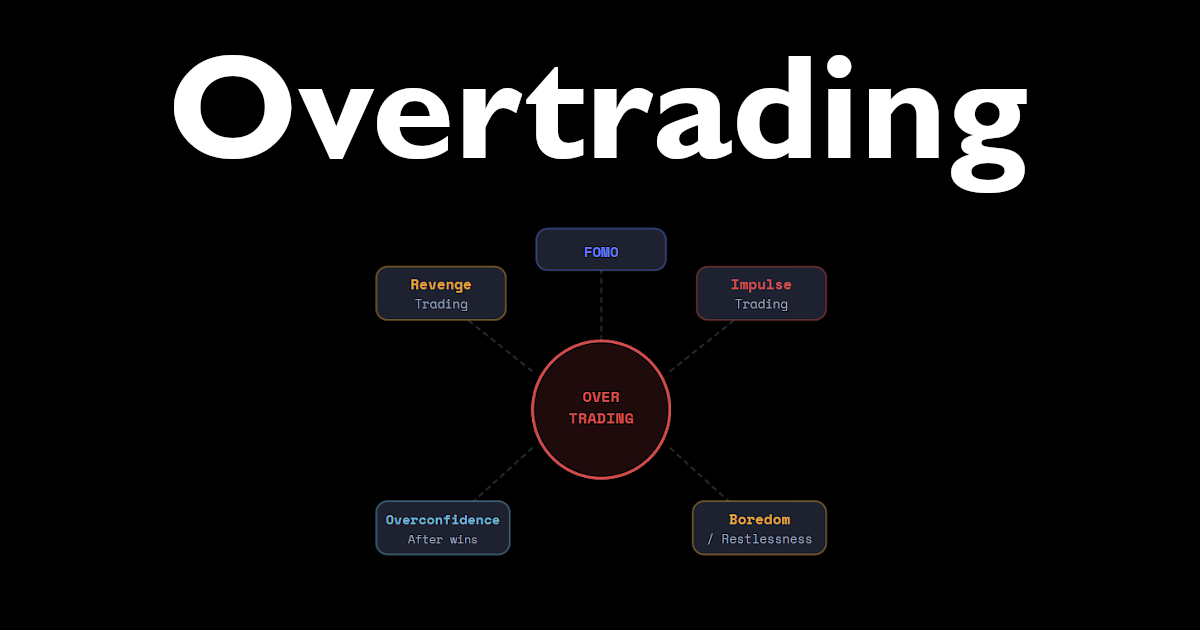
Overtrading is not just about taking too many trades, it's a symptom of deeper psychological loops like revenge trading, FOMO, and impulsive decision-making. Even highly skilled traders fall into this trap when discipline breaks down.
In this guide, we'll expose the psychology behind overtrading and give you a 3-rule behavioral checklist designed to stop the downward spiral before it torches your capital and confidence.

What Is Overtrading — and Why Smart Traders Fall for It
Overtrading happens when you execute more trades than your system or emotional state can handle responsibly. This can mean:
- Trading outside your predefined setups
- Increasing position size impulsively
- Re-entering trades right after losses
- Taking trades just to "make something happen"
According to a 2022 TD Ameritrade survey, 68% of active retail traders admitted to "emotional re-entry" after losses, with a majority citing fear, frustration, or boredom as the cause.
So why do even good traders fall victim?
The Hidden Cost of Trading Too Often
Overtrading eats into your profits in stealthy ways:
- Slippage and commissions compound quickly
- Emotional fatigue reduces your cognitive edge
- Overexposure to noise leads to poor decision-making
- You shift from strategy-based execution to reactionary gambling
The biggest danger? You won't even realize you're overtrading until your account balance screams it.
Overconfidence and the Illusion of Control
Behavioral finance experts like Dr. Brett Steenbarger have written extensively about how dopamine-driven trading creates a false sense of control. After a winning streak, traders often believe they're invincible, leading to impulsive trades and disregard for risk rules. This is how good traders destroy great systems: not from a lack of knowledge, but from an unchecked mindset.
The Emotional Drivers Behind Overtrading
Put simply, overtrading doesn't come from your strategy, it comes from your emotions.
The Revenge Trading Spiral
You lose a trade. It hurts.
So you jump into another without any signal, just to "win it back."
That second trade goes bad. Now you're frustrated, angry… maybe even ashamed. So you double down again, chasing to recover the loss.
This cycle is called revenge trading and it can evaporate weeks of disciplined progress in a single session.
"After a losing trade, your brain floods with cortisol. You're not in a rational state. Trading decisions made in that moment are rarely strategic."
— Dr. Alexander Elder, Trading for a Living
FOMO and Impulse Trading
On the flip side, there's FOMO, the fear of missing out. You see a big move without you and feel the pull to jump in mid-run.
This impulse hijacks your logic and pulls you into low-probability entries, often right before a reversal.
Together, FOMO and revenge trading account for the majority of non-systemic losses experienced by developing traders.
The Dangerous Mindset That Fuels Emotional Trading
There's a famous quote by Mike Tyson, "Everyone has a plan until they get punched in the face." The real problem isn't the punch, it's the illusion that your plan would prevent you from ever getting hit in the first place. This mindset is surprisingly common in trading.
Many traders spend months, even years, crafting their strategies. They backtest them across years of data. Then, they forward test in real-time. They trust their systems, but they're also a little too close to their systems. That confidence becomes overconfidence. And that's when the emotional cracks form.
Even when all your indicators align perfectly, your A+ setup, your edge, your timing, you can still lose. This is because trading is not a certainty game. It's a game of probability and randomness. When you forget this, and approach every trade expecting it to work simply because it's your plan, every loss feels like a betrayal. It's not. It's just math playing out over time.
But when you forget to frame your strategy and each trade through the lens of randomness and probability, losses hurt more, and they're far more likely to trigger revenge trades, "going on tilt", and overcorrections.
You're a Speck in a $100 Trillion Ocean: Know What You're Up Against
Retail traders often forget just how massive the financial markets really are and just how small their $100,000 account is in the grand scheme of things.
The global equities market alone is worth over $100 trillion. That includes institutional players (hedge funds, pension funds, sovereign wealth funds) who are trading with algorithms, insider access, and capital pools that dwarf your entire lifetime earnings.
When you revenge trade, it may feel like you're fighting a single stock or setup, but you're actually fighting a much larger current. One that's driven by:
- Sector rotations
- Institutional accumulation/distribution
- Economic macro trends
- Market-wide liquidity shifts
That's why revenge trading and overtrading rarely work: you're reacting to short-term noise while big money is positioning across longer-term trends.
This is why you need to zoom out and look at the broader picture:
- Check multiple timeframes (especially daily/weekly)
- Study sector ETFs and indexes for capital flow
- Understand where the "smart money" is likely focused
When you frame yourself properly—as a retail trader managing probability within a tidal market—it becomes easier to stop forcing trades and wait for aligned setups that flow with the current, not against it.
The 3-Rule Checklist to Stop Overtrading Cold
Rule #1: Set a Daily Trade Limit—And Honor It
Max trades per day: 3. That's it.
Why? Because this single rule forces intentionality. It creates a psychological buffer between impulse and action.
"You only get 3 bullets today. Use them wisely."

By limiting trades, you slow down, analyze deeper, and prioritize quality over quantity.
Pro Tips: 1) Set a platform alert once your trade count hits your limit. Many broker platforms support this. 2) You may want to start with only one trade per day and gradually work up to three trades. Or, you may want to periodically practice not trading. Watch an A+ setup pass you by and remind yourself that another train will pull into the station tomorrow. Learn to control your desire to trade.
Rule #2: Log Every Emotion in a "Red Flag" Journal
Most traders journal their technicals ... few journal their emotions.
That's the mistake.
Start logging things like:
- What were you feeling before the trade?
- Was this trade part of your plan, or was it an emotional reaction?
- What was your internal dialogue at the time?
- Did your execution match your strategy? If not, was this due to emotion?
Over time, patterns will appear: perhaps you always revenge trade after a loss. Or FOMO drives you to trade near the open. This awareness gives you power.
Rule #3: Wait for Signal Confirmation—Not Gut Instinct
If it's not in your system, it's not real.
Before entering any trade, run it through a simple checklist:
- Is this a setup I've backtested?
- Do I have a clear stop loss and target?
- Are there at least two forms of confluence (price action + indicator, or news + volume)?
- Am I calm and patient, or am I emotionally charged?
If you can't check those boxes, you're not in a trading mindset. You're in a reactive mindset, which means you're gambling, not trading.

Practice Doesn't Make Perfect. Only "Perfect Practice" Makes Perfect
Some experts caution against using trading simulators, claiming they lead traders to take unrealistic risks. That's true if you misuse the tool.
But a good simulator, used with intention, can train discipline far more effectively than backtesting or live small account trading alone.
Trading Blitz shows you randomized, anonymous stock charts. You start with a virtual balance of $100,000 , and your only goal is to grow your account using your rules.
Here's how to use Trading Blitz to reinforce the 3-rule checklist:
- Filter ruthlessly. Only trade charts that perfectly match your strategy's setup criteria. If it doesn't meet your edge, hit Next Chart. Fight the urge to trade every chart.
- One shot only. Once your setup appears, take your trade. If it fails, take your loss and move on. Fight the urge to overtrade, revenge trade, and FOMO.
- Practice risk management. Keep your risk per trade consistent.
- Track your mindset. Use a journal or the Notes section while you play. Record emotions that arise after a loss or during times when you overtrade.
Trading simulators aren't about winning. They're about building habits. Use them with discipline, and they become one of the best mental training tools available.
FAQs: Overtrading and Trading Discipline
Q: What is considered overtrading?
A: Trading too frequently without clear setups or risk parameters. Often tied to emotional responses, not strategy.
Q: How do I know if I'm revenge trading?
A: Ask: "Am I trying to make back a loss immediately?" If yes, you're in revenge mode.
Q: Should I trade every day?
A: Not unless your strategy calls for it. Many successful traders only act when high-probability setups arise.
Conclusion: Trade Less. Profit More.
Overtrading is a silent killer of trading careers—not because traders lack skill, but because they lose emotional control.
This 3-rule checklist isn't just a system, it's a reset switch for your trading mindset.
Bookmark it. Use it. Share it.
And watch your confidence, discipline, and P&L rise together.
Free Cash-Prize Touraments
We run free cash-prize tournaments (no entry fee required) when we go live on YouTube. Be sure to subscribe to our channel - @TradingBlitzSimulator - to get alerted when we go live next.
Disclaimer: Trading involves substantial risk of loss and is not appropriate for all investors. The information provided on Trading Blitz is for educational and informational purposes only. Nothing on this platform, including this article, constitutes financial advice, investment advice, or a recommendation to buy or sell any security. Simulated trading results do not guarantee or predict future performance in live markets. Past performance, whether real or simulated, is not indicative of future results. Always consult a qualified financial professional before making any investment decisions. For additional information, please see our Terms of Service.
Affiliate Disclosure: Some links in this article may be affiliate links. If you click through and make a purchase, Trading Blitz may earn a small commission at no additional cost to you. We only reference tools and resources we believe are relevant to traders.