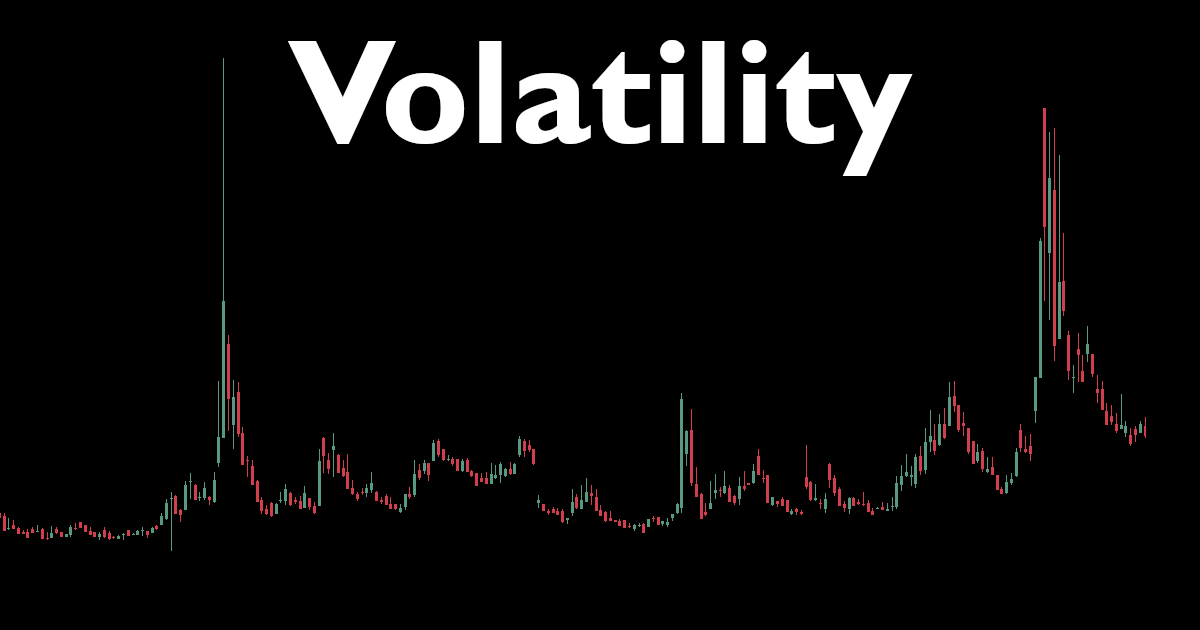
Market volatility is the great equalizer. It punishes the underprepared and rewards those who understand what's actually driving the chaos. Whether you freeze up when prices start whipping around or you find yourself overtrading out of excitement, developing a structured approach to volatile markets is one of the highest-leverage skills you can build as a trader.
This article breaks down what volatility actually is, why it creates both danger and opportunity, and which technical tools professional traders use to stay on the right side of it. You'll also get a specific assignment to practice at the end using the Trading Blitz simulator.
What Is Market Volatility and Why Does It Happen?
Volatility is simply the rate at which price changes over a given period. A stock that moves 1% per day is considered low-volatility. One that swings 5-10% per day is highly volatile. The CBOE Volatility Index (VIX), which measures expected 30-day volatility in the S&P 500, historically averages around 19-20. During periods of extreme stress, like March 2020, the VIX spiked above 82, a level that hadn't been seen since the 2008 financial crisis.

But why does volatility spike? The answer comes down to uncertainty and the breakdown of consensus. Under normal conditions, buyers and sellers more or less agree on a stock's fair value, and transactions happen smoothly near that consensus price. When unexpected news arrives, whether it's an earnings miss, a Federal Reserve rate decision, geopolitical conflict, or a sudden economic shock, that consensus evaporates. Buyers and sellers disagree sharply on what the asset is worth, and the resulting tug-of-war creates large, rapid price swings.
Institutional players like hedge funds and market makers also adjust their hedging activity during volatile periods. Market makers widen their bid-ask spreads to compensate for increased risk, which makes execution more expensive for everyone. Algorithmic trading systems, which account for a significant portion of daily volume, can amplify volatility by triggering cascading stop-loss orders or momentum-chasing signals simultaneously. According to a 2023 report from the Bank for International Settlements, algorithmic trading now accounts for an estimated 60-75% of equity market volume in the U.S., meaning that machine-driven reactions to data or news can be nearly instantaneous and dramatically amplify short-term price swings.
Understanding this is important because it tells you that volatility is not random noise. It is the market repricing risk in real time, and that process follows recognizable patterns that technical analysis can help identify.
How To Manage Risk Effectively During High Volatility
Before discussing specific strategies, risk management deserves serious attention because it's the reason most retail traders blow up during volatile markets. A study by FINRA found that retail traders who fail to use stop-loss orders experience drawdowns roughly 3x deeper than those who consistently apply them. Protecting your capital is not optional during turbulent conditions. It is the entire game.
Here's what adjusting for volatility actually looks like in practice:
- Reduce position size. If you normally risk 2% of your account per trade, consider cutting that to 1% or less during periods of elevated volatility. Larger price swings mean your stop losses get hit more frequently, so smaller position sizes preserve capital across more attempts.
- Widen stops appropriately. This sounds counterintuitive, but setting a stop too tight during volatile conditions almost guarantees you'll get shaken out before the trade plays out. Use the Average True Range (ATR) indicator to calibrate your stop distance to current market conditions. If ATR is double its normal reading, your stop should reflect that.
- Accept fewer, higher-conviction setups. The temptation to overtrade spikes during volatility because price action feels full of opportunities. Experienced traders actually reduce their trade frequency during high-volatility environments, waiting only for the clearest setups with the most favorable risk-reward ratios.
What Technical Indicators Work Best for Volatile Market Conditions
The Relative Strength Index (RSI) and Momentum Extremes
The RSI, developed by J. Welles Wilder in 1978, measures the speed and magnitude of price changes on a scale of 0 to 100. Readings above 70 traditionally indicate overbought conditions, while readings below 30 indicate oversold conditions. During volatile markets, these extremes become more frequent and more meaningful.
The why here is important: when fear drives a stock to RSI levels below 30, it often reflects panic selling rather than rational repricing. Institutional buyers, sometimes called "smart money," tend to step in at these extreme levels because they recognize the discount and have the capital to absorb selling pressure. This creates the setup for sharp reversals, which is exactly why oversold bounces during volatile markets can be some of the most powerful short-term moves you'll ever see.
However, in strongly trending down markets, RSI can stay oversold for extended periods. Always confirm with price structure, like a support level or reversal candlestick pattern, before acting on RSI alone. Learn more about how RSI can help you find better entries.
MACD Crossovers as Momentum Confirmation
The Moving Average Convergence Divergence (MACD) indicator, also developed by Gerald Appel in the late 1970s, compares a 12-period exponential moving average to a 26-period EMA. The resulting MACD line crosses above or below its 9-period moving average (signal line), generating bullish and bearish signals respectively.
During volatile markets, MACD crossovers are most useful as confirmation tools rather than primary signals. A bullish MACD crossover that occurs while price is holding above a key support level is significantly more reliable than a MACD crossover in isolation. The indicator reflects a shift in the balance of buying and selling momentum, which is exactly what you want to see when trying to time an entry after a volatile selloff. Learn how Gerald Appel used multiple MACD indicators and practice it on the simulator.
Engulfing Candlestick Patterns at Key Levels
Engulfing patterns occur when a candle's body completely contains the prior candle's body. A bullish engulfing pattern forms when a large green candle follows and engulfs a smaller red candle. A bearish engulfing does the opposite. These patterns are particularly potent in volatile markets because the large candle represents a decisive shift in who controls the price action at that moment.

The reason these patterns work comes down to market psychology and order flow. When a large bullish engulfing candle forms at a known support level, it signals that buyers overwhelmed sellers in a single session. Institutional algorithms and discretionary traders alike recognize this as a sign that the supply at that level has been absorbed. The result is often an imbalance that drives prices higher in the short term.
Gap Analysis in Volatile Conditions
Gaps occur when a stock opens significantly above or below the prior day's close, leaving a blank space on the chart with no trading activity. They are far more common during volatile periods because after-hours news, earnings reports, and macro events can dramatically reprice a stock before the opening bell.
Research published in the Journal of Finance has shown that roughly 70% of gap-ups in strong trending stocks tend to continue in the direction of the gap during the first trading session. However, gaps into resistance or after an extended move often get "filled," meaning price reverses back to close the gap. The key is context: a gap in the direction of the prevailing trend, supported by strong volume, is a continuation signal. A gap against the trend, or on declining volume, is a warning that a reversal may be coming.
3 Professional Frameworks for Adapting to Changing Volatility
- Scale with the VIX. Many institutional traders use the VIX as a position-sizing guide. When VIX is elevated (above 30), reduce exposure. When it contracts below 15, expand exposure. The VIX closing above 30 has historically corresponded with periods where the S&P 500 generated its best forward 12-month returns, suggesting that extreme fear often precedes recovery.
- Wait for the second wave. The first move in a volatile market is often the most violent and the least reliable to trade. The second move, once initial panic or euphoria fades and price begins to retest the prior extreme, tends to offer a much cleaner entry with better-defined risk.
- Use ATR to set dynamic stops. Rather than applying a fixed percentage stop, anchor your stop to the Average True Range. A stop set at 1.5x ATR below your entry adapts to current volatility conditions, reducing the risk of being prematurely stopped out.
How To Practice Trading Volatile Markets on the Trading Blitz Simulator: The Connors RSI Pullback Strategy
For this assignment, you'll practice a strategy developed by Larry Connors, a quantitative trader and co-author of "Short Term Trading Strategies That Work." Connors spent years backtesting short-term mean reversion strategies across thousands of stocks, and his research consistently found that stocks experiencing sharp short-term pullbacks within a longer-term uptrend tend to snap back quickly. This makes his approach particularly well-suited to volatile market environments.
Connors' research showed that buying short-term RSI(2) pullbacks in stocks trading above their long-term moving average produced win rates above 65% across thousands of historical trades, according to backtests published in his book. The strategy takes advantage of the tendency for institutional buyers to step in at short-term discounts within strong uptrends.
Strategy Rules: Connors RSI(2) Mean Reversion in Volatile Markets
Setup:
- Add two Simple Moving Averages (SMA) to the chart: a 5-period SMA and a 200-period SMA.
- Add RSI with a period setting of 2 (not the default 14).
Entry Conditions (Long):
- Price must be above the 200-period SMA (confirming a long-term uptrend).
- RSI(2) must close below 10 (indicating an extreme short-term oversold condition).
- Enter the trade at the market on the next day's close after conditions are met.
Exit Conditions:
- Exit when price closes above the 5-period SMA. This typically captures the mean reversion move without overstaying.
- Place a stop-loss at 1.5x the current ATR(14) below your entry price to manage downside risk. Note - This was not part of Connors' original strategy. In fact, he didn't use stop loss orders at all, finding that they hurt profitability. Instead, he managed risk through position size. You should experiment with and without using stop loss orders to see which performs best for you.
Short Side (Optional for advanced traders):
- Price must be below the 200-period SMA.
- RSI(2) must close above 90.
- Exit when price closes below the 5-period SMA.
Your Assignment on Trading Blitz:
- Log in to Trading Blitz and start a Solo session.
- Reset Game History in the simulator dashboard to remove old data from your statistics.
- Load new charts until you find one where price has been in a clear uptrend for an extended period, trading well above where the 200-period SMA would sit.
- Add the 5-period SMA, 200-period SMA, RSI(2), and ATR(14) to your chart using the indicator panel.
- Advance through the chart bar by bar using the Next Day button. Wait for RSI(2) to drop below 10 while price holds above the 200 SMA.
- Enter long at the market when conditions are met. Place a stop-loss order based on 1.5x ATR below your entry.
- Hold until price closes above the 5-period SMA, then exit.
- Record your observations in the Notes section of the simulator.
- After 20 trades, review your statistics in the Dashboard and save them somewhere. Compare your results to Connors' published backtested results as well as the results we found in our tests (see video below).
- Next, clear your Trade History and start the test over. This time change your exit parameters and compare the results with your first test. Keep modifying your test parameters until you find a strategy that works.
- Bonus: If you are a Premium member, test this strategy when using the Pullback filter.

The goal isn't to blindly replicate Connors' numbers. It's to learn how to develop the muscle memory of identifying short-term oversold conditions within uptrends and making disciplined, rule-based entries. Volatile markets create those RSI(2) spikes frequently, making this an excellent strategy to sharpen your execution during periods of market stress.
Video
We created a video that goes into depth on Connors' two-period RSI strategy:
Free Cash-Prize Tournaments
We run free cash-prize tournaments (no entry fee required) when we go live on YouTube. Be sure to subscribe to our channel - @TradingBlitzSimulator - to get alerted when we go live next.
Citations
- CBOE Volatility Index (VIX) historical data. Chicago Board Options Exchange. cboe.com
- Bank for International Settlements. (2023). "Algorithmic and High-Frequency Trading in Equity Markets." BIS Quarterly Review.
- Connors, L., & Alvarez, C. (2009). Short Term Trading Strategies That Work. TradingMarkets Publishing Group.
- Wilder, J. W. (1978). New Concepts in Technical Trading Systems. Trend Research.
- Appel, G. (2005). Technical Analysis: Power Tools for Active Investors. Financial Times Press.
- FINRA Investor Education Foundation. Retail investor trading behavior and risk management data. finrafoundation.org
Disclaimer: Trading involves substantial risk of loss and is not appropriate for all investors. The information provided on Trading Blitz is for educational and informational purposes only. Nothing on this platform, including this article, constitutes financial advice, investment advice, or a recommendation to buy or sell any security. Simulated trading results do not guarantee or predict future performance in live markets. Past performance, whether real or simulated, is not indicative of future results. Always consult a qualified financial professional before making any investment decisions. For additional information, please see our Terms of Service.
Affiliate Disclosure: Some links in this article may be affiliate links. If you click through and make a purchase, Trading Blitz may earn a small commission at no additional cost to you. We only reference tools and resources we believe are relevant to traders.